EventSat
- My role
- Communications subsystem lead
- Topics
- CubeSatevent cameraspace situational awarenesscommunications
- Links
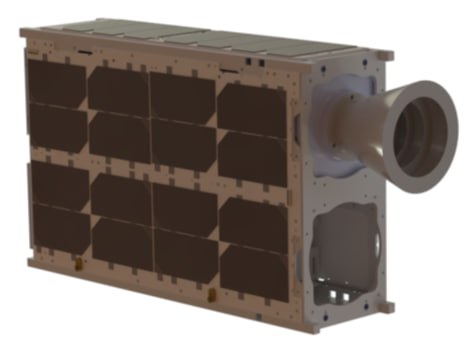
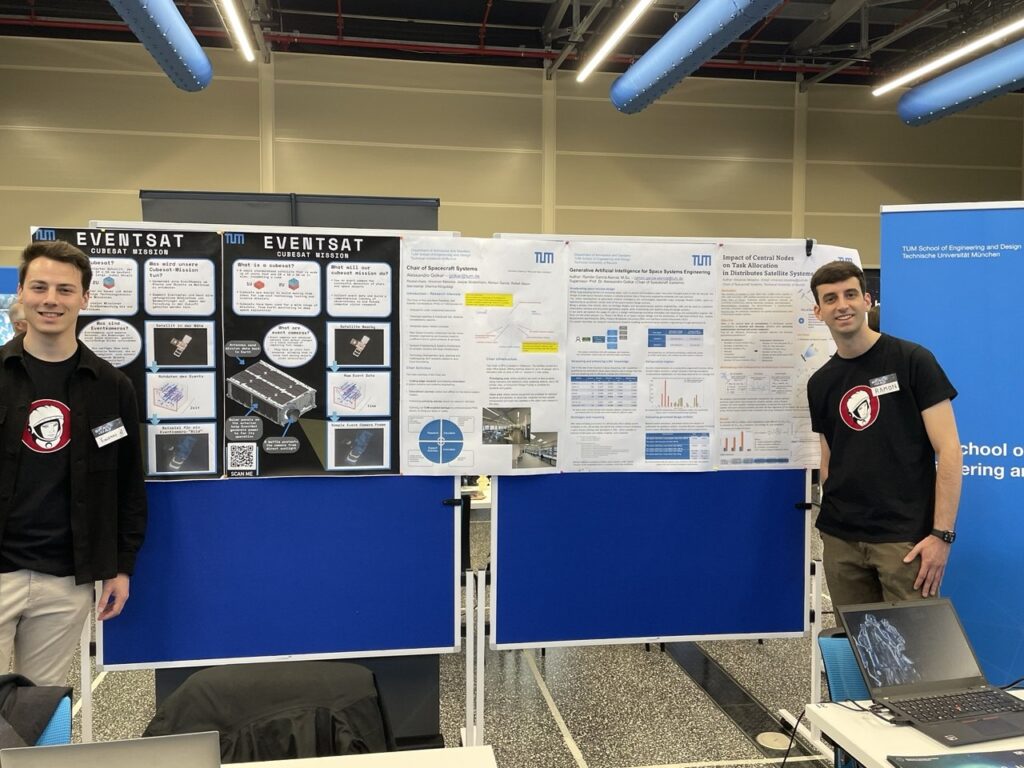
EventSat is a 6U CubeSat mission of the TUM Chair of Spacecraft Systems. It will test an event-based (neuromorphic) camera in low Earth orbit to observe stars, satellites and space debris, with on-board detection [1, 2, 3].
I lead the Communications subsystem: the radio links that bring the science data down and keep the satellite commanded and monitored from the ground.
More about the mission and the team at eventsat.space.
Related publications
[1]
PUB-26-01
R. M. García Alarcia, S. Dolan, J. Sindermann, C. J. Juan Oliver, L. Schuberth, V. Messina, F. Salmaso and A. Golkar
conferenceProceedings of the 5th Symposium on Space Educational Activities (SSEA 2026), 2026
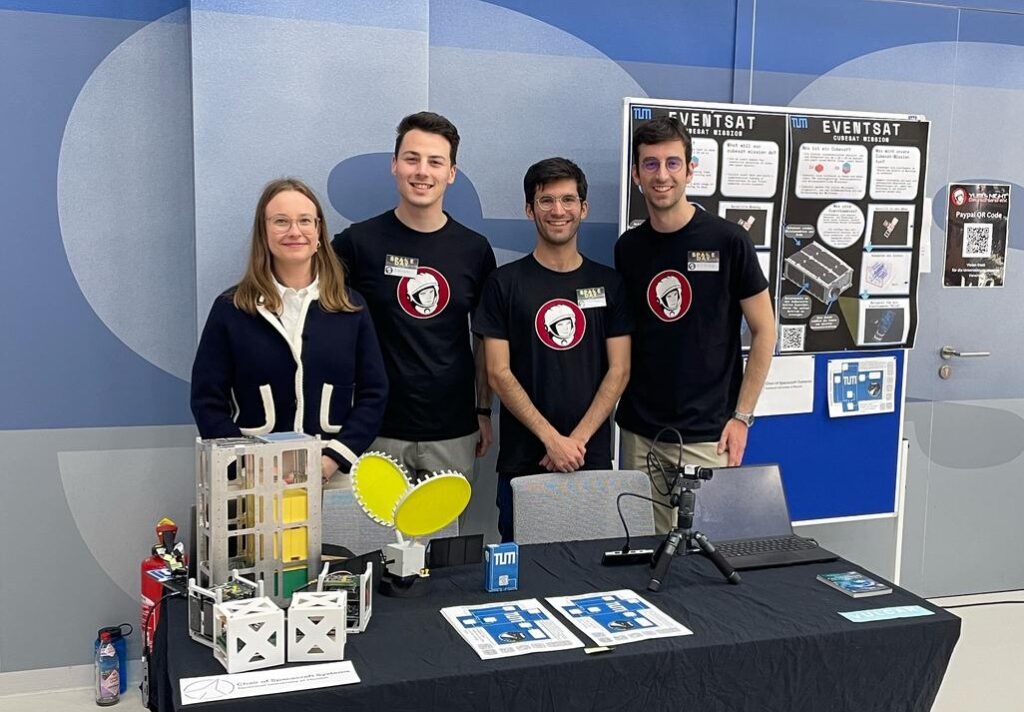
EventSat is a student-driven mission aimed at demonstrating space-based detection, classification, and identification of objects by leveraging neuromorphic vision. The mission consists of a 6U CubeSat with commercial-grade subsystems and a payload comprising an event camera and a commercial-off-the-shelf embedded AI computer. As part of the mission, algorithms are developed for event compression and object detection, taking into account the camera's very low latency and the specific characteristics of event data. The data may inform space objects catalogues for Space Situational Awareness (SSA). The EventSat mission serves as a platform for both academic and educational activities, allowing for the research and development of novel vision technologies and algorithms for their application in space, as well as providing training opportunities for students through hands-on learning with real space hardware. In this paper, we provide insights into the student-based structure of the team and the educational projects associated with it, with a focus on the impact on student learning through their involvement in the mission.Keywords: Event camera, CubeSat, satellite mission, educational mission
[2]
PUB-24-05
L. Schuberth, V. Messina, R. M. García Alarcia, J. Sindermann, K. Bostani Nezhad, R. Aldea Velayos, S. Lennerstrand, J. Rollet, F. Sofio, A. Tinucci Monibas, L. Kessler and A. Golkar
conferenceProceedings of the 75th International Astronautical Congress (IAC 2024), 2024
Event-based cameras introduce an innovation in the field of imaging by departing from the conventional frame camera paradigm. These bio-inspired sensors capture per-pixel brightness changes asynchronously, generating a continuous stream of events that encode information such as time, pixel location, and polarity alterations. This departure from traditional imaging methods results in distinctive features including high temporal resolution, a high dynamic range, low power consumption, and minimized motion blur. Additionally, event cameras are ideal for motionoriented applications as they remove superfluous information, optimizing data generation and algorithmic performance. Such characteristics position event-based cameras as useful tools in challenging scenarios as in the realm of object observation in orbit. This paper presents a comprehensive mission architecture study for our nanosatellite space mission, called EventSat, that focuses on autonomous object detection, classification, and identification in Low Earth Orbit (LEO). The main objective of the mission is to leverage the unique capabilities of event-based sensors for enhancing Space Situational Awareness and autonomous space operations. The nanosatellite mission aims to demonstrate event-based technology to address the growing challenges of monitoring and understanding objects in space, particularly in the densely populated LEO for the sustained, long-term usage of orbital resources through the technological demonstration of event cameras integrated with onboard AI. The core components of the proposed mission include the integration of event-based cameras with advanced onboard artificial intelligence (AI) systems. This integration holds the promise of significantly advancing autonomous object detection, classification, and identification techniques in space. The ability to exploit the inherent advantages of event-based cameras, such as high temporal resolution and very high dynamic range, can lead to more accurate and timely Space Situational Awareness. The autonomous onboard AI algorithms can empower data sharing between federated spacecraft for automatic maneuvering and collision avoidance, among others. Furthermore, this paper delves into preliminary payload parameters and demonstrates the viability to use an event camera payload as a proof of concept on a 6U platform, selecting an initial range of focal length for further investigations. The presented analysis shows what payload parameters will maximize the product of pixel count and number of objects, considering looking directly at known objects or looking for chance encounters. We propose how the payload could be used in space in accordance to the selected parameters and point out further work that will allow us to refine and select from the identified possibilities. EventSat aims to bridge the gap between cutting-edge sensor technology and practical space applications, ultimately fostering advancements in space exploration and surveillance capabilities, and empowering space autonomy for safer and more optimal space operations.Keywords: Event-based cameras, Nanosatellite mission, Object detection, Space Situational Awareness, Artificial intelligence in space
[3]
PUB-25-01
S. Dolan, L. Schuberth, R. Arge, R. M. García Alarcia, V. Messina, C. J. Juan Oliver, F. Salmaso, J. Sindermann, F. Sofio Avogadro and A. Golkar
conference15th IAA Symposium on Small Satellites for Earth System Observation, 2025
The EventSat mission is a technology demonstration mission of a 6U CubeSat by Technical University of Munich to apply event cameras for resident space object detection. Event cameras are asynchronous sensors that detect changes in pixel brightness, providing data updates at a microsecond temporal resolution with low power consumption. We perform an initial analysis of the limiting apparent visual magnitude for the Prophesee EVK4, accounting for parameters like dark current, quantum efficiency, and optic aperture diameter. Initial simulations estimate that the sensor will be able to detect visual magnitudes up to 7.7. Then, we perform a parametric analysis relating the qualities of different resident space objects like their speed, brightness, and size; and the optic qualities of the sensor like its f-number and contrast threshold. This analysis constraints the types of detectable space objects for the planned mission. Finally, we discuss the development of a single-stage baffle for our event camera. Baffles reduce stray light from nearby bodies, which is important for our mission to detect dim objects within its limiting magnitude. We estimate initial baffle sizing, and conduct trade-off studies on vane dimension, placings, and exclusions angles. These results help define the mission's pointing and operational requirements.Keywords: technology demonstration, event cameras, baffle