← Projects
Project · 2025 – 2026

SSEA 2026

My role
Vice-Chair · proceedings editor
Topics
symposiumspace educationESA
Links
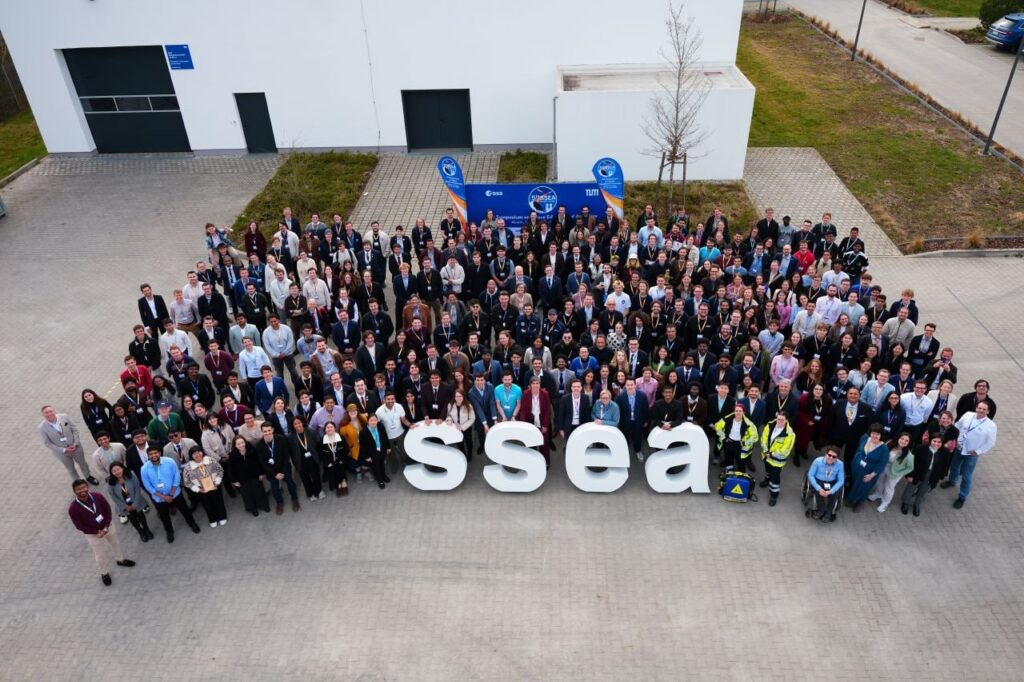
Participants of the 5th SSEA, Munich, April 2026

For a year I helped lead the 5th Symposium on Space Educational Activities, co-organised by ESA and TUM in Munich on 8–10 April 2026, as Vice-Chair overseeing the different aspects of the organisation. The organising committee and volunteers were led by Prof. Gisela Detrell. I also edited the whole proceedings book, published open access on mediaTUM [1].

At the symposium I presented our paper on the EventSat mission [2], organised a visit to the TUM Chair of Spacecraft Systems and the Mission Control Center on our campus for the social visits evening, and was one of the hosts of the closing ceremony.

This edition welcomed more attendees than ever: more than 500 people, about 170 oral and 50 poster presentations.

Thanks to the whole organising committee and volunteers, to ESA for its trust, and to the TUM School of Engineering and Design, our sponsors, partners, reviewers, judges and session chairs.
Related publications

[1]
PUB-26-04
G. Detrell, R. M. García Alarcia, V. Messina and A. Kinnaird (eds.)
editorTechnical University of Munich, 2026
doi mediatum
Proceedings book of the 5th Symposium on Space Educational Activities (SSEA 2026), co-organised by ESA and TUM in Munich, 8–10 April 2026. I edited the whole proceedings book.Keywords: space education, symposium proceedings
[2]
PUB-26-01
R. M. García Alarcia, S. Dolan, J. Sindermann, C. J. Juan Oliver, L. Schuberth, V. Messina, F. Salmaso and A. Golkar
conferenceProceedings of the 5th Symposium on Space Educational Activities (SSEA 2026), 2026
pdf bibtex doi mediatum
EventSat is a student-driven mission aimed at demonstrating space-based detection, classification, and identification of objects by leveraging neuromorphic vision. The mission consists of a 6U CubeSat with commercial-grade subsystems and a payload comprising an event camera and a commercial-off-the-shelf embedded AI computer. As part of the mission, algorithms are developed for event compression and object detection, taking into account the camera's very low latency and the specific characteristics of event data. The data may inform space objects catalogues for Space Situational Awareness (SSA). The EventSat mission serves as a platform for both academic and educational activities, allowing for the research and development of novel vision technologies and algorithms for their application in space, as well as providing training opportunities for students through hands-on learning with real space hardware. In this paper, we provide insights into the student-based structure of the team and the educational projects associated with it, with a focus on the impact on student learning through their involvement in the mission.Keywords: Event camera, CubeSat, satellite mission, educational mission