CADMUS
- My role
- Electronics & software
- Topics
- BEXUSstratospheric balloonmuonselectronics
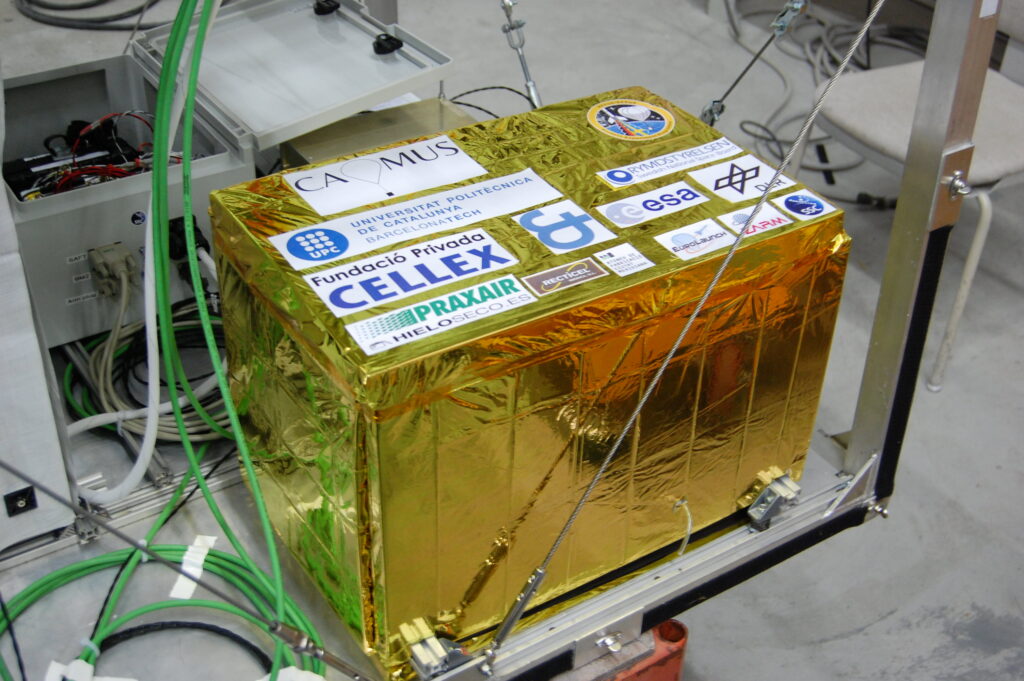
In 2017 I was part of the small team behind CADMUS (Cloud chamber for high-Altitude Detection of Muons Under Special relativity effects), an experiment in the ESA and Swedish National Space Agency BEXUS programme, launched to the stratosphere on a high-altitude balloon in October 2017 [1].
I was responsible for electronics and software, and also worked on structure, management and outreach, which let me follow a space mission from its concept through design, construction and launch to the analysis of results.
Related publications
[1]
PUB-20-02
G. Megías Homar, R. Bahí Buhigas, R. M. García Alarcia, G. Pascual López and A. Teixidó Bonfill
conferenceProceedings of the 3rd Symposium on Space Educational Activities (SSEA 2019), 2020
CADMUS was a student-made experiment with the aim of measuring the flux of muons at different altitudes and experimentally verifying time dilation, one of the effects predicted by the Special Relativity Theory. It was developed in the frame of the REXUS/BEXUS Programme and flew to the stratosphere on a high-altitude balloon in October 2017. This paper discusses its development, from inception to launch, from the perspective of space educational activities.Keywords: student-made experiment, particle detector, cloud chamber, muons, Special Relativity Theory, time dilation, REXUS/BEXUS Programme, stratosphere, high-altitude balloon, education