Generative AI for space mission design
- My role
- PhD research
- Topics
- LLMssystems engineeringrequirementsDSMOPMontologiesfine-tuning
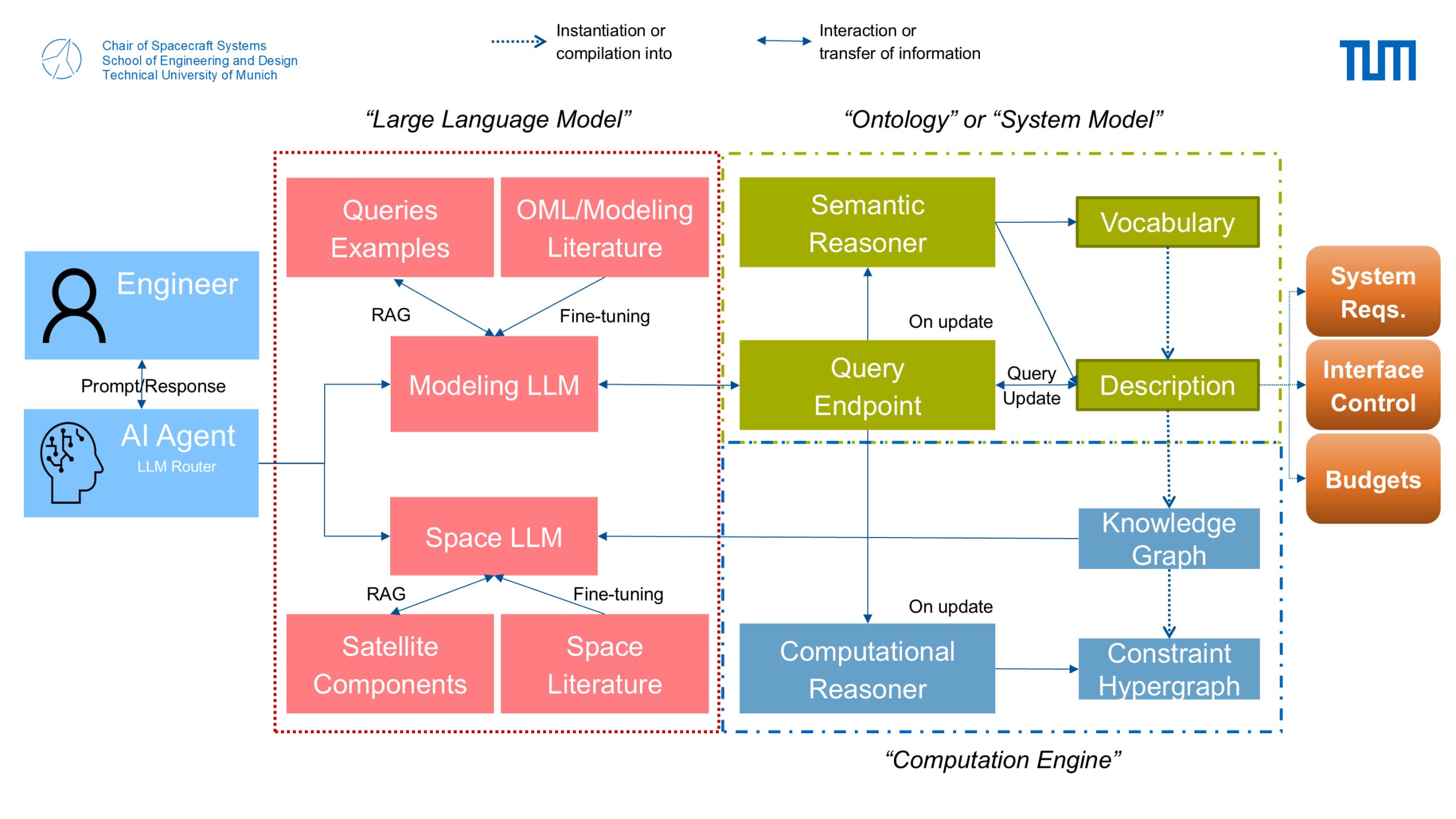
My doctoral research at the TUM Chair of Spacecraft Systems, since November 2022 and supervised by Prof. Alessandro Golkar, studies how generative AI can support space mission and spacecraft design. I look at bounded aspects of the problem such as:
- generating numerical system requirements [1, 2], and assessing how similar LLM-generated requirements are to expert ones [3];
- grounding language models in systems engineering models such as OPM and ontologies [4, 5];
- using the Design Structure Matrix to structure and shorten LLM conversations [6];
- a roadmap for generative AI in the design of complex systems [7];
- fine-tuning small, open-source LLMs to generate systems and ontological modelling code, and how (and how not) to evaluate LLM-generated engineering artefacts [5].
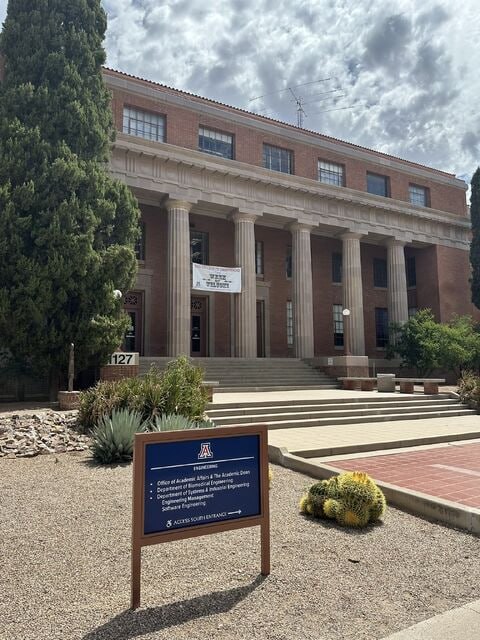
In autumn 2025 I spent a semester as a Visiting Scholar in Prof. Alejandro Salado’s Disruption Lab at the University of Arizona, working on LLM copilots for system modelling within a NASA JPL project with Maged Elaasar; this led to two CSER 2026 papers [3, 5].
Related publications
[1]
PUB-23-02
R. M. García Alarcia and A. Golkar
conference74th International Astronautical Congress (IAC), 2023
closed access (IAF library) — copy on request
This work presents the architecture of a generative design tool that supports decision-making during the conceptual design of space missions. The tool generates the technical specifications of a spacecraft given a high-level mission statement expressed in natural language by the user. The tool includes a chatbot front-end which can be employed by users to query the model and ask questions on the design of the mission of interest. The work demonstrates the utility of the tool both as means of a design aid for engineers but also for augmentation of the dataset and underlying language model themselves. The work is in the frame of the design and construction of space missions and spacecraft, which have evolved significantly over the past few decades. Space mission design processes still rely heavily on human intervention despite the availability of large flight heritage data for varied types of missions and satellites, which can be handled in unprecedented ways by machine learning models. Advancements in computational power and in such machine learning techniques -particularly in transformer architectures for language- offer now however the potential to automate and speed up the design process, reducing even more costs and barriers to access space. In this paper we demonstrate a use case of our generative design tool prototype focused on Earth Observation missions. The goal of the prototype is to select instruments and provide key technical specification ranges starting from user needs expressed in natural language. Users can interact with the tool through a chatbot implementation. The bot provides an opportunity for user feedback to further refine the answer provided by the tool and converge iteratively to a technically feasible solution. Future iterations of the tool will include broadening the scope to a wider variety of satellite missions, as well as extending the scope of the tool to additional tasks in the conceptual design process, such as translating technical specifications to a CAD configuration model of the spacecraft involved as well as orbit design and other relevant design tasks.Keywords: generative design, spacecraft design, large language models, design assistant
[2]
PUB-24-04
R. M. García Alarcia and A. Golkar
conferenceProceedings of the 75th International Astronautical Congress (IAC 2024), 2024
The design of spacecraft, and more broadly of space missions, can greatly benefit from LLM-based design assistants supporting engineers in the extraction of relevant information from past missions for its reuse in the new one, as well as in the automatic generation of system parameters or requirements in text at different levels. However, due to the mathematical nature of technical systems, many of the spacecraft parameters or requirements are numerical and involve calculations or the application of first principles. While Large Language Models excel at text generation, predicting the next words in a sequence with the highest probability, they are not suited, being statistical engines, to perform deterministic computations. In this paper, we present the architecture of a computation engine to which numerical calculations are outsourced during the process of generating parameters or requirements by an LLM-based design assistant. We present the integration with the LLM, measure its performance, and benchmark and discuss the improvement in parameters generation with a space mission as a use case. In particular, the computation engine hereby developed follows an object-oriented programming paradigm, mimicking through the classes the subsystems of a spacecraft, through the class properties their parameters, and through the class functions the equations and first principles used to calculate the parameters' values, which can be then expressed by the LLM as numerical system parameters or requirements with natural language. A high-level programming language and a modular approach are followed in seek of high readability and modifiability, allowing the engine to be extended and its granularity increased in future iterations. Different alternatives for the integration of the computation engine with the LLM and in the design flow are evaluated and compared, and parameters such as the computation speed and error are measured and assessed along different computation platforms. By presenting this computation engine for spacecraft design, we aim at patching the shortcomings of LLM-based design assistants in numerical calculations, paving the way for their adoption and thus helping accelerate and simplify spacecraft design tasks for a broader range of institutions and individuals.Keywords: spacecraft design assistant, computation engine, numerical system parameters, Large Language Model, Generative AI
[3]
PUB-26-02
R. M. García Alarcia, A. Golkar and A. Salado
conference23rd Annual Conference on Systems Engineering Research (CSER 2026), 2026
A potential application of LLMs in SE is the production of sets of requirements for a particular problem. In this paper, we survey how researchers evaluate the quality of requirements generated by LLMs and assess the adequacy of such approaches. Particularly, we show that metrics traditionally employed to evaluate the similarity of LLM-generated artifacts against ground truths do not perform well for requirements. The underlying reason is that similarity ought not to be achieved on the textual output but on the problem space captured by the requirements.Keywords: requirements, large language models (LLM), CoPilot, semantic similarity, cosine similarity
[4]
PUB-24-01
R. M. García Alarcia, P. Russo, A. Renga and A. Golkar
conferenceProceedings of the 12th International Conference on Model-Based Software and Systems Engineering (MODELSWARD 2024), MBSE-AI Integration, 2024
Although showing remarkable zero-shot and few-shot capabilities across a wide variety of tasks, Large Language Models (LLMs) are still not mature enough for off-the-shelf use in engineering design tasks. Organizations implementing model-based systems engineering practices into their product development processes can leverage on ontologies, models, and procedures to enhance LLMs applied to engineering design tasks. We present a methodology to integrate an Object-Process Methodology model of a space system into an LLMbased spacecraft design assistant and show a performance improvement, as compared to a conventional LLM. The benchmark is evaluated through subjective expert-assessed and an objective cosine-similarity-based criteria. The results motivate additional efforts in integrating Model-Based Systems Engineering practice into LLMs as means to improve their performance and reduce shortcomings such as hallucinations and black-box, untraceable behavior.Keywords: Large Language Models, Systems Engineering, Model-Based Systems Engineering, Object-Process Methodology, Engineering Design, Design Assistant
[5]
PUB-26-03
R. M. García Alarcia, A. Alhamadah, M. Elaasar, A. Golkar and A. Salado
conference23rd Annual Conference on Systems Engineering Research (CSER 2026), 2026
An increased number of specialized Large Language Models (LLMs) are being released recently, supporting a variety of domain-specific tasks at a fraction of the inference cost of general-purpose LLMs. The Systems Engineering community, with a fragmented landscape of modeling languages, could benefit from specialized LLMs for system modeling tasks, bringing down barriers that prevent adopting Model Based Systems Engineering (MBSE). However, the community does not yet have a well-established corpus of specialized LLMs, nor fine-tuning methodologies tailored to the specificities of its languages. In this paper, we contribute a methodology to fine-tune LLMs for small, underrepresented modeling languages. Using the generic Ontological Modeling Language (OML) as a reference, we explore the balance between the fine-tuning an LLM and using a general-purpose one.Keywords: ontology modeling, systems modeling, LLM, CoPilot, fine-tuning, OML
[6]
PUB-24-03
R. M. García Alarcia and A. Golkar
conferenceProceedings of the 26th International DSM Conference (DSM 2024), 2024
As Large Language Models become ubiquitous in many sectors and tasks, there is a need to reduce token usage, overcoming challenges such as short context windows, limited output sizes, and costs associated with token intake and generation, especially in API-served LLMs. This work brings the Design Structure Matrix from the engineering design discipline into LLM conversation optimization. Applied to a use case in which the LLM conversation is about the design of a spacecraft and its subsystems, the DSM, with its analysis tools such as clustering and sequencing, demonstrates being an effective tool to organize the conversation, minimizing the number of tokens sent to or retrieved from the LLM at once, as well as grouping chunks that can be allocated to different context windows. Hence, this work broadens the current set of methodologies for token usage optimization and opens new avenues for the integration of engineering design practices into LLMs.Keywords: Large Language Models, token usage optimization, context window, output tokens, Design Structure Matrix
[7]
PUB-25-03
R. M. García Alarcia and A. Golkar
conferenceComplex Adaptive Systems Conference (CAS 2025), MIT, Boston; published in Procedia Computer Science, 2025
This paper sets the foundation for a roadmap aimed at improving the efficiency of designing complex systems by leveraging generative AI. Our focus is on integrating generative AI, specifically LLMs, with semantic system models and computation engines to improve system design capabilities. We introduce a prototype assistant tool for the design of space systems, validate it and demonstrate an improvement in the efficiency of the design process with a comprehensive case study, that includes the design of Earth Observation missions benchmarked to the European Sentinel infrastructure and the EventSat mission we are developing. The tool generates, among others, typical design artifacts such as System Requirements Specifications, Product Breakdown Structures, and Interface Control Documents. We validate it through the cosine similarity of the produced text to the ground truth, a design structure matrix to compare system dependencies and strength and manual evaluation with experts. Validation results align closely with the ground truth. Design time and associated development costs are significantly reduced when using the tool, promising an improvement in efficiency. We contextualize our work in the broader context of developing generative AI for the design of complex systems, by presenting a technology roadmap with our vision of future developments. We discuss the potential of incorporating generative AI into the design of complex systems, the status of technology and the necessary developments. Generative AI integration will enable efficient complexity management, paving the way for innovative advancements in systems engineering.Keywords: generative artificial intelligence, complex adaptive systems, space systems, engineering design